How hybrid work became the norm
From paper files to digital workplaces
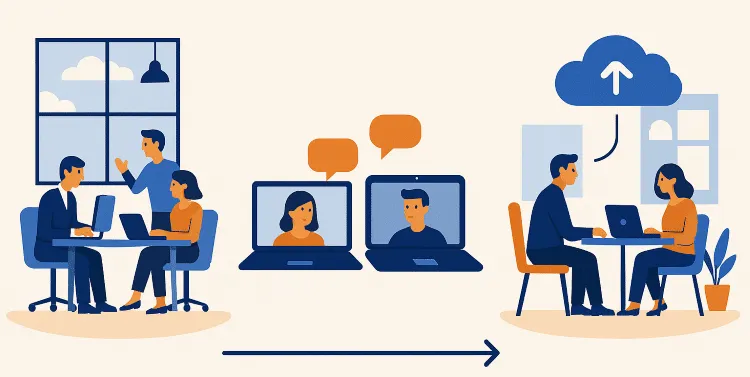
Five years after the first lockdown, one thing is clear: the way we work has changed forever. Hybrid work, a mix of working from home and the office, is today the standard in Belgium. But how did we get here? And more importantly: how do you make sure your company keeps up with this evolution?
A short history of the modern workplace
In the early 2000s working from home was still an exception. Only 6 to 8% of Belgian employees occasionally worked from home. The infrastructure simply did not exist yet: if you wanted to work from home, you often had to log on to a local server through slow VPNs, and that was usually reserved for IT staff or managers.
By 2019 that share had risen to 18.9%, a doubling largely thanks to the rise of technologies such as VDI (Citrix, VMware Horizon), cloud platforms like Microsoft Azure and the broad adoption of Exchange Online, SharePoint and OneDrive. Thanks to these tools companies could make their data and communication securely available outside the office walls.
The modern workplace started to take shape, but working from home was not yet the standard.
COVID-19 as the accelerator
The real breakthrough came with COVID-19. In 2020 the share of home workers rose to an average of 29%, with peaks of up to 36% during lockdowns. Companies had to switch to remote working en masse, and thanks to the technological foundations built earlier that could happen relatively quickly. [Source: Statbel]
Since then, hybrid work has been impossible to imagine away. According to PwC, 68% of Belgian teleworkers today work partly from home and partly at the office, more than the global average of 58%.
Why we have the tools we need today
What made this revolution possible? Technology. More specifically: the cloud.
In the past every SME ran its own mail server in a broom closet. Today everything lives in the cloud: e-mail, documents, meetings, planning, security. Thanks to solutions such as Microsoft 365 Business Premium employees can collaborate securely from anywhere, without the company having to invest in expensive infrastructure.
And it does not stop at e-mail and Word. Think of:
- Microsoft Teams for video meetings
- SharePoint and OneDrive for document management
- Intune for device management
- Defender for Business for built-in security
These tools are not only powerful, they are also scalable and affordable, perfect for SMEs.
How Dunetrails makes your workplace safe and efficient
At Dunetrails we help companies not only build their modern workplace, but also secure and manage it. Because technology is great, but only if it is used well.
What we do:
- Tailored security: we make sure your Microsoft 365 environment complies with the CCB's Cyber Fundamentals. Think of MFA, data protection, backups and monitoring.
- Smart management: with Intune and Autopilot we make sure devices are set up, updated and secured automatically, without your IT team having to work overtime.
- Cybersecurity training and guidance: we help your team work safely and consciously in a digital environment. Think of recognising phishing, handling company data with care, using MFA correctly and following security policies. Because technology only truly works when people know how to protect themselves digitally.
Want to know more about how we do that? Check our page about the services we offer: Scalable Security for SMEs | Dunetrails
Conclusion: hybrid work is not a trend, it is the new standard
The modern workplace is flexible, digital and secure. But it also calls for vision and management. With Microsoft 365 Business Premium you have the right tools in hand. And with Dunetrails you have the right partner to use them smartly and securely.
Want to know how your company can make the switch to a modern workplace? Get in touch below and we will gladly help you further.